
funny-snowman4Q. Like many east coast employers preparing for the impending blizzard, we want to know how we calculate FMLA leave if our office is closed due to the weather. I have an employee out on FMLA.  Do I count the snow day against this employee’s 12-week leave entitlement?

A. Although the FMLA rules do not directly address this question, the general rule for counting FMLA leave during a holiday week would likely apply. So, if the employee is out on FMLA for the entire week, then yes, you can count the snow day against the employee’s 12 weeks of FMLA leave. If the employee worked any part of the week, then only the days the employee would actually have been expected to report to work should be counted as FMLA leave.

Note that this rule applies for closures of less than a week. If an employer’s operations are shut down for one or more full weeks (for example, if your roof collapses under the snow and shuts down operations for a few weeks while repairs are made), any days the employee would not be expected to work should not be counted against the employee’s FMLA leave entitlement.

East coast friends — hope your snowblowers are working.  Those of us west of you will be enjoying the warm glow of El Nino (assuming you call 30 degrees in Chicago “warm“)!

draw the lineOne of the most difficult issues an HR professional or in-house employment counsel faces is how to deal with an employee who cannot return to work after FMLA leave expires. Is additional leave beyond 12 weeks required? The answer is almost always ‘yes.’ But how much leave are we obligated to provide? And what if the employee already has taken months of leave and doesn’t really know when she’ll return?

Take, for instance, a situation involving Penelope.  We’ll call her Pippy, for short.

Pippy suffered from sarcoidosis (inflammation of the lungs) and arthritis related to her condition. In September, she inquired about reducing her work schedule as an accommodation for her condition. Before her employer responded, however, Pippy suffered an injury that aggravated her medical condition.  The injury caused Pippy to take time off in December and January, and in February, she stopped working.

Between February and May, Pippy’s employer sent her multiple letters requesting documentation of the injury, but she didn’t respond. In June, her employer told her that she either had to report to work or provide medical documentation supporting her need for leave. Soon thereafter, Pippy sent her employer a “disability certificate” signed by her doctor indicating that the injury suffered a few months earlier left her “totally disabled” and she would remain so “indefinitely.” In contrast to her physician, however, the employee told her employer that she “hoped” to return by September 2007. Unwilling to wait any longer for Pippy’s uncertain return, her employer terminated her employment.

Like a typical, litigious former employee, Pippy filed suit.  It didn’t last long.  Pippy forgot one basic principle — an employer is never required to provide an employee an indefinite leave of absence. Particularly after the employer has already provided a reasonable amount of leave as an accommodation to help the employee return to work.

Like many others have done in similar situations, this court dismissed Pippy’s ADA claim in large part because her employer provided her a reasonable amount of leave (here, three months), and she could not provide a reasonable estimation of her return to work.  In other words, she was asking for an open-ended, indefinite leave of absence.  Courts almost always will support an employer’s right to terminate employment in instances like these.  Other employers should take note — when an employee cannot provide a reasonable estimate of when they will again be able to perform their essential job duties, their ADA claims skate on thin ice.  Minter v. District of Columbia (pdf)

But let’s not be too confident…

In situations like these, it is imperative that employers engage in the interactive process with the employee to determine whether any accommodation is available to help the employee return to work. When employers don’t, they risk significant liability under the ADA.

Just ask the Wayne Township Fire Department.  The Fire Department hired Kristine as a reserve paramedic in February 2009 and as a full-time paramedic a few months later, knowing that she had Type 1 diabetes. While on the job, Kristine’s blood-sugar levels dropped on two occasions while she was on duty — once while she was driving and again while she was caring for a patient in the back of an ambulance. Kristine told her supervisor and other officials what had happened.  Shortly thereafter, she was told she could not return to work without approval from the agency’s medical director, who refused to return her to work because she could not “guarantee” any further incidents. Declining to engage in any interactive process, the Fire Department simply terminated Kristine’s employment.

That cha-ching sound is the Fire Department’s cash register, which opened wide to the tune of $725,000 to pay Kristine for its ADA violations and her attorney’s fees.  Rednour v. Wayne Township Fire Dept. (pdf)  One of the “fundamental” issues for the jury’s verdict in favor of Kristine? The mere fact that the employer did not engage in the ADA’s interactive process.

Think about it: Three-quarters of a million dollars simply because the employer failed to engage in the interactive process.  What a waste.

In her analysis of Kristine’s case, Miriam Rosen identifies several steps that an employer should take to identify accommodations in situations like these.  I really liked her suggestions, so I paraphrase them here:

  • Obtain information from the employee and employee’s physician (through the employee, of course) to understand the medical condition and how it affects the employee’s ability to perform essential job functions.
  • Identify the essential job functions that the employee must perform with or without an accommodation. Up-to-date job descriptions are key to this process.
  • Do not make assumptions about whether the employee can or cannot perform the essential job functions. Rather, engage in a dialogue with the employee about what modifications would help the employee perform the essential job functions. Consider whether other options for accommodation are available if the suggested accommodations are not reasonable.
  • Determine if it is possible to provide reasonable accommodations that allow the employee to perform the essential functions of the position. Remember that accommodations such as a leave of absence or, if available, light duty may allow the employee to perform job functions within a reasonable time.
  • If an accommodation is identified, put it into place. If it is not possible to provide a reasonable accommodation, communicate that to the employee as well and any employment related consequences.
  • Document the process and outcomes to establish that obligations to engage in the interactive process have been met.

Engage in a meaningful interactive process. Conduct an individualized assessment. Be creative in providing accommodations to keep the employee on the job.  Avoid liability.

Easier said than done, right?

‘Tis the season for employer-sponsored holiday parties. And I’ve been queried several times about whether an employer should invite to the annual holiday party all of those employees who presently are on FMLA leave.

Several of you are already shouting at me through your computer screen or mobile phone: “Nowak, why the %*#@&* would we ask employees to attend a holiday party when they should be off work?” After all, some might argue that allowing employees on FMLA leave to attend sends the wrong message to the employee’s co-workers that it is permissible take leave from work while at the same time attending an employer-sponsored party and revel with their co-workers.

I enjoyed one comment, in particular, posted on social media on this issue:

In our younger days we were always led to believe that if you called out sick from school then you were not allowed to participate in the extracurricular activities of that day. The same thought should be viewed as adults, in the professional world.

Funny.

Seriously though, friends.  Let’s not forget we are in the human relations business.

Clearly, if an employee is utilizing FMLA leave for his or her own serious health condition, the employee should not be required to attend an employer-sponsored holiday party. At the same time, an invite to the holiday can be quite a powerful thing — it communicates to your employee that you care about them, you consider them to be part of the team, and that you want to keep them engaged even though they are not presently at work.

Let me take this a step further: Might an employer even have an obligation to extend the invite? While on FMLA leave, the employee still is entitled to enjoy the benefits and privileges of employment, and should be free of discrimination or retaliation because they are on leave. (See 29 CFR 825.220) Therefore, if the employee is able to do so, he/she should be invited and permitted to attend the party.

In the end, it seems to me to make a whole lot of sense.  Don’t you think?

Keith was a manager for Costco. By all accounts, he wasn’t a very good employee.  The store disciplined Keith over customer complaints, dress code violations, and failing to perform his job duties.  Consequently, he was placed on a performance improvement plan. Shortly after receiving the PIP, Keith told a subordinate that he planned to take FMLA leave “to secure his managerial rate of pay and position in the event of demotion.” This employee then reported the conversation to the store’s managerial staff because the employee was concerned that Keith was going to “scam” the company. The store promptly demoted Keith to a cashier position as a result of the report.

Two days after the demotion, Keith requested and was provided FMLA leave. During his leave, he requested a transfer to a different store, but his current store refused because he remained on FMLA leave. After his doctor released him to work, he was transferred to a position at a different store.

Keith immediately filed an FMLA and ADA lawsuit, claiming that the Company interfered with his FMLA leave when it demoted him and refused to allow him return to work when he requested.  He also added an FMLA retaliation claim.

Insights for Employers

The problem with Keith’s lawsuit?  Let me count the ways:

1.  The Company demoted him before he took FMLA leave.  Additionally, he did not provide proper notice of the need for FMLA leave when he told his subordinate that he was seeking FMLA leave. Because Keith did not follow the Company’s very specific policy for requesting FMLA leave, his request was not protected under the FMLA.

2.  Even if notice to the subordinate was enough to trigger the FMLA, Keith’s conduct still was not protected because the Company honestly believed that Keith was trying to “scam” the store, as reported by the other employee.  The Court put it this way:

Keith failed to produce any evidence that [his manager], or any other Costco manager, did not rely on the information gained from [Keith’s subordinate] in deciding to demote him. Keith was on a 90-day PIP at the time of his comment to the subordinate.  Costco honestly believed Keith violated its Manager Standard of Ethics by contemplating a fraudulent medical leave, and Keith presented no evidence to dispute this fact.  [My emphasis]

Based on the information it received from the subordinate, Costco surely had the right to suspect that Keith might be abusing leave. Me thinks, however, that Costco dodged a bullet when it did not conduct an investigation into Keith’s alleged comment.  As I have referenced in a previous post, courts typically will support an employer’s “honest belief” defense only after they have conducted a complete and exhaustive investigation into the facts.  The court reviewing this case didn’t fault Costco for failing to conduct an investigation, but the risk is that a different court easily could have, which would have required the Company to head to trial on Keith’s FMLA claims when they otherwise never should have seen the light of day.

3.  What about Keith’s request to transfer to another store while he was out on FMLA leave?  The Court’s response to this issue is helpful in practice for employers: Simply put, employers “are under no obligation to restore an employee to his or her position if the employee is unable to perform the essential functions of the job.”  Here, Keith remained on FMLA leave, so he clearly could not perform the functions of the job — whether at his current store or at another store.  As a result, Costco was well advised to keep Keith on leave and deal with the transfer request when he was able to perform the essential functions of his demoted cashier position.

The Curtis v. Costco court decision can be found here (pdf).

Blawg100HonoreeBadgeMy dear blog readers:

I am delighted to announce that our FMLA Insights blog has been selected for the fifth consecutive year as one of the Top 100 Legal Blogs of 2015 by the ABA Journal! In its 9th Annual ABA Journal Blawg 100, we were only one of six employment blogs to receive the honor.

I am honored and humbled by the many attorneys, HR and leave professionals and other friends of the blog who nominated our blog for this honor. In this week of all weeks, I am so thankful for your support of my little FMLA blog. Thousands subscribe to the blog, and tens of thousands more visit our site every month. Thank you! Thank you! Thank you!

If you are not subscribed to our blog, please enter your email in the box to the right so that our posts can be sent directly to your Inbox, or feel free to add us to your RSS feed.

Congrats to the other employment blogs who made the list – they are worth the read:  Eric Meyer’s The Employer Handbook, Robin Shea’s Employer and Labor Insider, and Donna Ballman’s Screw You Guys, I’m Going Home,  A hearty congratulations to my friend Jon Hyman, whose Ohio Employer’s Law Blog, was voted into the blogging Hall of Fame this year!

Much to be thankful for this year.  Happy Thanksgiving!


P.S. Some of you may not be familiar with the ABA or the ABA Journal.  Here is some background, so you have some context for our blogging award:

About the American Bar Association (ABA)  www.abanet.org 

With nearly 400,000 members, the American Bar Association is the largest voluntary professional membership organization in the world. As the national voice of the legal profession, the ABA works to improve the administration of justice, promotes programs that assist lawyers and judges in their work, accredits law schools, provides continuing legal education, and works to build public understanding around the world of the importance of the rule of law.  Quick note: On December 1, 2015, I will be a panelist in an ABA webinar entitled, “FMLA: The Basics that You Need to Know“! This webinar will be of benefit to your colleagues just getting started out administering FMLA. Please register here!

About the ABA Journal www.abajournal.com

The ABA Journal is the flagship magazine of the American Bar Association, and it is read by half of the nation’s 1.1 million lawyers every month. It covers the trends, people and finances of the legal profession from Wall Street to Main Street to Pennsylvania Avenue. ABAJournal.com features breaking legal news updated as it happens by staff reporters throughout every business day, a directory of more than 4,000 lawyer blogs, and the full contents of the magazine.


webinar1.jpgThanks to those who attended my webinar last week on FMLA and ADA Overlap Issues.  If you missed the program, you can download our presentation here (pdf).

In a mere hour plus, Sara Elder, (Division Vice President, Fair Employment & Compliance, for Sears Holdings Management CorporationMatt Morris (Vice President at ComPsych) and I covered a number of FMLA and ADA overlap conundrums, such as:

  • Handling an employee’s request not to work overtime or more than eight hours in a day
  • Managing an employee’s sporadic, yet frequent absences after the employee exhausts FMLA leave
  • Responding to an employee’s request for a new supervisor due to stress caused by the workplace
  • How many extensions of leave is an employer legally obligated to provide after an employee exhausts FMLA leave

And we sang a Thanksgiving jingle. Which, of course, was god-awful. Thankfully, this can be skipped over in the recording.

During the webinar, some common themes emerged:

  • When a triggering event occurs (e.g., a request for leave), the interactive process is paramount.  The employee’s request must always be taken seriously, and it is critical that the employer engage the employee to determine whether any accommodations exist that would enable the employee to perform the essential functions of his job. We outlined what this engagement should look like.
  • The determination regarding whether a requested leave must be granted as a reasonable accommodation requires a fact-intensive inquiry.  We provided attendees a very specific approach to handling requests for leave as a reasonable accommodation, focusing on: 1) how an employer should deal with vague and/or non-responsive information from the employee and the health care provider; and 2) how an employer can identify the undue hardship on the employer’s operations as a result of the employee’s continued absence.  To borrow a phrase from Sara during the webinar, “leave is not a destination . . . it’s a tool to help the employee get back to work.”  Well said.
  • An employer absolutely can insist on an employee’s regular and reliable attendance. However, where the FMLA and ADA are implicated, how you communicate and document your attendance expectations sets the foundation for taking appropriate and lawful personnel actions at a later time.  The path is full of potholes, however, so we recommended an approach to maneuver around those landmines.
  • Beware of automatic termination policies & examine “no fault” attendance policies.  Although these policies are not per se illegal, we discussed how to practically and lawfully implement them in your workplace.
  • When it comes to leave and reasonable accommodations, don’t assume a leave of absence is the only option.  We highlighted considerations for alternative accommodations, including reassignment.

Thanks again to those who attended the webinar. I look forward to your feedback on the issues we discussed.

Edepartment-of-labor-300x300arlier this month, I had the pleasure of presenting on complex FMLA issues at the American Bar Association’s Annual Labor and Employment conference. During the session, entitled “The FMLA 20 Years Later,” we covered key FMLA notice and medical certification issues and other difficult FMLA scenarios.

Notably, one of my co-panelists, Andrea Appel, Regional Counsel for Civil Rights in the Department of Labor’s Philadelphia office, reminded employers of the DOL’s key focus on systemic FMLA problems during their investigations of employers’ FMLA practices.  As I have reported in my previous blog posts, the DOL’s interest in systemic issues means that the agency will regularly broaden its FMLA enforcement to identify compliance problems that impact multiple employees and multiple employer locations.  With increasing regularity, the DOL will move beyond a single complainant to an entire group, department, employer location and onto multiple employer locations to ensure compliance across a company’s work sites.

As reported by Thompson Information Services, who was covering our ABA conference session, and as I have reported in my previous blog posts, the DOL’s systemic investigations will generally take aim at three types of information:

  • statistical — leave trends, leave requests, leave approvals and responses to leave requests by supervisor, job group, type of request or any other grouping;
  • anecdotal — based on interviews with employees, supervisors, administrators and managers; and
  • documents — records of leave requests, notices provided, leave determinations, employer’s FMLA policy and handbook, and medical certifications and re-certifications.

Insights for Employers

This is yet another reminder that employers will continue to face scrutiny by the DOL on their FMLA procedures, and that they increasingly will become party to consent decrees where their FMLA practices do not adhere to the FMLA regulations.

I know I sound like a broken record, but as you prepare your HR and legal budgets for 2016, make an FMLA self-audit a priority for your workplace in the New Year.  As I have highlighted in a previous post, your self-audit should focus on the following:

  1. Conduct a thorough review of your FMLA policy. Important compliance alert: the DOL will review an employer’s FMLA policy and all of its FMLA forms to ensure that the March 2013 regulations are incorporated in these documents. As to your policy, is it up to date? If you have an employee handbook, is your FMLA policy included (along with the contents of the FMLA poster)? Moreover, does your policy incorporate issues such as: eligibility requirements; the reasons for FMLA leave; the definition of your 12-month FMLA leave year; requirements for bonding leave/placement in foster care or adoption; your call-in procedures; substitution of paid leave; the employee’s obligations in the FMLA process; medical certification process; explanation of intermittent leave; benefit rights during leave; fitness for duty requirements; outside work prohibitions during FMLA leave?
  2. Adhere to the Employer Posting Requirements. In addition to posting your FMLA policy in your handbook, employers also must post the DOL’s FMLA poster “prominently” where it can be viewed by employees and applicants. If a substantial portion of your workplace speaks a language other than English, you must provide the poster in that language.
  3. Ensure your FMLA forms are legally compliant. Examine all existing FMLA forms to determine whether they comply with FMLA regulations. A technical violation of the FMLA can be costly, so employers should ensure that their FMLA forms (Notice of Eligibility and R&R Notice, certification forms, Designation Notice) are all up to snuff.
  4. Prepare legally compliant FMLA correspondence. In addition to the forms above, be sure to put in place and review legally compliant correspondence regarding certification, recertification, failure to provide certification, insufficient/incomplete certification, employee’s return to work, second/third opinions. These communications also will be reviewed by the DOL during an investigation.
  5. Conduct a comprehensive audit of your FMLA practices and procedures. A couple immediately come to mind: a) What procedures are used by managers when an employee reports an absence that may be covered by the FMLA? Are they asking the correct questions to determine whether FMLA applies? (See a previous post that recommends several intake questions.) b) Do the procedures you follow ensure that all requests for leave, regardless of whether “FMLA leave” is expressly requested, reach the appropriate manager or Human Resources? c) How are you calculating increments of intermittent leave (and are you following the DOL’s new rule on this issue?) d) Are you complying with the FMLA regulations when seeking medical certification, curing certification, contacting health care providers to clarify certification, and seeking second and third opinions? e) Are you properly designating FMLA leave and providing timely notice to employees of the designation? f) Are you seeking recertification within the time periods allowed by the regulations and you’re not being overzealous in seeking recert in violation of the rules? g) Do you have compliant procedures for contacting and checking up on an employee while he/she is on FMLA leave? h) Are you following the regulations’ very specific guidelines for seeking fitness-for-duty certifications from employees returning from FMLA leave? Don’t have answers to these questions (or worse yet, you don’t have a clue about what I’m referring to)? All the more reason to pull in your in-house or employment counsel on this self-audit.
  6. Clean up your recordkeeping now. Are you maintaining all the data DOL will be looking for, and are your data accurate? Employers should have ready their employees’ identifying information, their payroll data, date(s) of FMLA leaves, FMLA hours/days/weeks taken, copies of employer and employee FMLA notices, certification forms, benefit documents, and disputes about designation of FMLA leave. These documents should be maintained for at least three years, and they should be kept separate from the personnel file.  As the DOL’s Appel made clear in our ABA presentation, the DOL will be making fairly broad information requests, so excellent recordkeeping is imperative.
  7. Train your employees! Over the years, the DOL has picked up on one important fact: your managers do not know your FMLA policy and leave procedures, so you better get a handle on this because these managers are creating a liability for you.  Indeed, there are far too many examples of employers who have paid out a whole lot of money because their manager said something foolish about FMLA, did not properly handle an absence covered by FMLA, or did not follow the FMLA regulations. Managers at all levels can drastically increase your liability when it comes to FMLA. Training them now immediately reduces your risk of liability — both in court and as a result of a DOL investigation.

fraud-finalQ. In trying to reduce the amount of FMLA abuse in our Company (about 30% usage), we are contemplating having employees returning from FMLA leave complete a form that asks why they were out, had they been out for this reason before (and when), and that they took leave for the reason they provided. Can we implement this procedure without violating the FMLA?
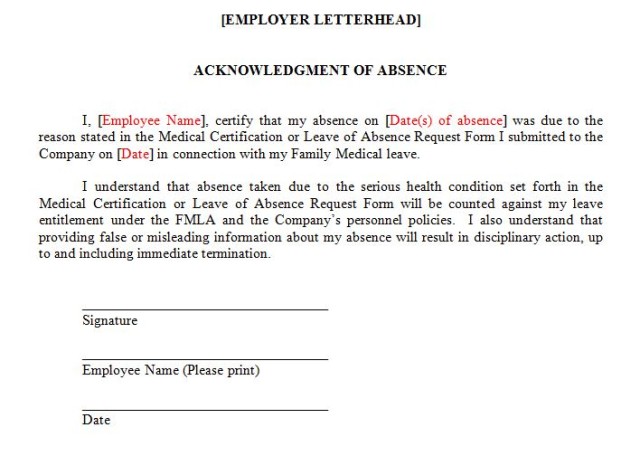
A.  This procedural requirement does not necessarily run afoul of the FMLA, but I have some concerns about FMLA interference if you only require it for employees returning from FMLA leave.

As an initial matter, you have the right to ask your employees questions about their leave of absence so as to determine whether FMLA applies. So, asking them why they were out and whether they’ve been out for this reason before is acceptable. In fact, I encourage you to ask these questions up front.  (See Tip #2 below)

Asking them to confirm that they actually took leave for the reason provided? This is where it gets a bit tricky. My concern in asking this kind of question is the risk that it tends to treat differently those who are returning from FMLA leave versus those who are returning from other forms of leave, thus causing the employer to be susceptible to an FMLA interference claim. Here, the argument is that the employer is treating the FMLA folks differently than other employees when it requires them to complete a form attesting to their FMLA usage.  As a result, a plaintiff’s attorney will argue that your practice denies the exercise of FMLA rights, which is prohibited by the FMLA regulations. 29 CFR 825.220(a)(1)

To avoid the risk of an FMLA claim, it’s best to implement this procedure for an employee returning from any leave of absence — FMLA or for another medical reason.  My suggested form goes something like this:

Personal certification

The benefit of using this kind of form is fairly straightforward: In the event that the employee takes leave inconsistent with the stated reason, the employer can discipline him/her for falsification of employment records. In doing so, you avoid having to make the argument that they abused FMLA leave, which comes with some tricky legal analysis. Here, you simply argue that the employee falsified a record and you took action as you would in any other situation where an employee falsified a document.

Other Tips to Combat FMLA Abuse

Fortunately for employers, there are several tools available to combat FMLA abuse.  In addition to the Personal Certification outlined above, I’ve made the following suggestions to clients:

  1. Require that Employees complete a written leave request form for all absences. Although an employer cannot deny FMLA leave if the employee provides verbal notice of the need for FMLA leave and they articulate an unusual circumstance as to why they could not follow proper procedures, requiring the employee to put a leave request in writing and return it to Human Resources tends to deter them from gaming the system.
  2. Prepare a list of probative questions you ask of all employees when they ask for time off. Employers have the right to obtain information from the employee about their need for leave. Prepare a list of questions that you ask your employees when they call in an absence.  These will help you better determine whether FMLA is in play and if the request might be fraudulent:

– What is the reason for the absence?

– What essential functions of the job can they not perform?

– Will the employee see a health care provider for the injury/illness?

– Have they previously taken leave for this condition? If so, when?

– [If they are calling in late in violation of the call-in policy], when did the employee first learn he/she would need to be absent? Why did they not follow the Company’s call-in policy?

– When do they expect to return to work?

  1. Enforce call-in procedures. Employers typically may deny FMLA leave (and potentially discipline the employee) if the employee fails to follow your customary call-in procedures, absent an unusual circumstance.  (See questions to ask the employee above.)
  2. Certify … and Recertify! Clearly, one of the best tools to fight FMLA abuse is the use of medical certification at various intervals: initially to verify the serious health condition; every new leave year; every time the reason for leave changes or the employee requests an extension.  Employers should require recertification: at regular intervals; if the frequency or duration of the absences changes significantly; if there is a pattern of suspicious absences; or if the employer receives information that casts doubt on the reason for leave.  Keep your employees honest – require them to certify their absence and seek recertification at the earliest opportunity.
  3. Scheduling Medical treatment Around Your Operations. Require that employees make a reasonable effort to schedule medical treatment around your operations and consider temporarily transferring employees (to an equivalent position) where leave is foreseeable based on planned medical treatment. Too many employers simply give up on this requirement, allowing employees to call the shots as to when they will obtain medical treatment, and the employee’s preference is smack dab in the middle of the workday.
  4. Conduct a comprehensive audit of your FMLA practices. Work with your employment counsel to ensure that your FMLA policy and forms are up to date, that you are employing the best strategies to combat FMLA abuse and that your FMLA administration is a well-oiled machine.

A question was posed to me on Twitter this past week: Shouldn’t former University of Southern California (USC) football coach Steve Sarkisian have been placed on FMLA leave to get treatment for apparent alcoholism instead of getting sacked by USC? [Pun intended, of course.]

For those of you not familiar with Mr. Sarkisian, according to multiple reports, the second-year USC football coach allegedly showed up intoxicated to a team meeting last week. This behavior followed reports that he showed up drunk to a football booster event earlier this year, and even other reports that he was suspected to be under the influence during a USC game a few weeks back.

One day after forcing the coach on an “indefinite” leave of absence, USC reversed course and terminated Sarkisian’s employment after considering “what is in the best interest of the university and its student athletes.”

Does the FMLA Protect Coach Sarkisian in this Situation?

Since alcohol was involved, wasn’t USC required to place the coach on FMLA leave, instead of terminating his employment outright?

In a word, no.

The FMLA regulations make clear that leave relating to substance abuse need only be given when the employee is seeking treatment based on a referral by a health care provider — not when he shows up intoxicated at work. Here’s the regulation:

FMLA leave may only be taken for treatment for substance abuse by a health care provider or by a provider of health care services on referral by a health care provider. On the other hand, absence because of the employee’s use of the substance, rather than for treatment, does not qualify for FMLA leave. 29 C.F.R. § 825.119(a).

Insights for Employers

1.  Hold Your Employee to Reasonable Performance Standards.  Both the FMLA and ADA allow an employer to hold an employee dealing with alcoholism to the same job performance standards as other employees. As a result, the employer has the right to discipline an employee who abuses alcohol and fails to perform the job. Based on the facts provided to USC, the University was well within its right to terminate the coach instead of offering FMLA leave.

2.  Maintain a policy prohibiting substance abuse.  Under the FMLA regulations, “if the employer has an established policy, applied in a non-discriminatory manner that has been communicated to all employees, that provides under certain circumstances an employee may be terminated for substance abuse, pursuant to that policy the employee may be terminated whether or not the employee is presently taking FMLA leave.”  29 CFR 825.119.

In light of this DOL rule, it is imperative that employers maintain a written policy providing that an employee may be terminated for substance abuse.

3.  Keep in mind though — if an employee is not being disciplined for violating a substance abuse policy but simply advises the employer that he intends to take time off for substance abuse treatment, this is a legitimate basis for FMLA leave. In these situations, the employer must provide FMLA leave.

4.  USC placed the coach on leave but then abruptly terminated his employment the following day. Is this an FMLA problem? No. Simply put, an employee’s absence or performance issues due to his abuse of a substance is not afforded any protection under the FMLA. So long as USC can establish that it made the termination decision as a result of the coach’s conduct, and not because he was in the process of seeking treatment, it’s on solid footing.

5. Even the EEOC supports an employer’s right to take action where the employee violates a workplace policy prohibiting the use of alcohol. Yep, you read that correctly. According to Question 26 of the EEOC’s guidance, the “ADA specifically permits employers to prohibit the use of alcohol or the illegal use of drugs in the workplace. Consequently, an employee who violates such policies, even if the conduct stems from alcoholism or drug addiction, may face the same discipline as any other employee. The ADA also permits employers to require that employees not be under the influence of alcohol or the illegal use of drugs in the workplace.”

webinarIt’s Webinar Time!

When managing an employee with a medical condition, the issues involved regularly implicate the FMLA or ADA — or both. Using interactive case studies, we will address critical FMLA and ADA compliance considerations when dealing with the most difficult employee leave and accommodation scenarios.

Please join us on Thursday, November 12 (12:00 – 1:15 p.m. central time) for “Where ADA and FMLA Overlap:  Leaves, Accommodations and Headaches, Oh My!” I will be joined by Sara Elder, (Division Vice President, Fair Employment & Compliance, for Sears Holdings Management Corporation) and Matt Morris (Vice President at ComPsych).

And the best part? It’s FREE!

During the webinar, Sara, Matt and I will highlight the most difficult FMLA/ADA overlap issues employers face and identify practical solutions to help employers stay compliant. Among other topics, we will address:

  • Requests that implicate the FMLA and ADA and whether leave and/or workplace accommodations are necessary
  • Employee requests for a “less stressful position” – is it an FMLA or ADA issue?
  • Examine the roles of HR and managers and provide tools and best practices for effective communication during the leave management and accommodation processes
  • ADA Intermittent leave!?! Do we have to?
  • When discussing “reasonable accommodations,” what does “reasonable” mean? Reasonable to whom?
  • The age old question: When FMLA ends, how much additional leave must an employer provide before terminating the employee?

This session promises to be practical and fun. As has become our custom, we might even throw in a Thanksgiving tune to finish things off.

This program has been submitted to the HR Certification Institute for review. For more information about certification or recertification, please visit the HR Certification Institute website at www.hrci.org.

Illinois MCLE credit also will be available to attorneys attending the program. For attorneys in states other than Illinois, we will provide proof of attendance, but CLE credit will be governed by your particular state’s rules.

Looking forward to dining on FMLA and ADA with you.