

‘Tis the season for employer-sponsored holiday parties. And I’ve been queried several times about whether an employer should invite to the annual holiday party all of those employees who presently are on FMLA leave.
Several of you are already shouting at me through your computer screen or mobile phone: “Nowak, why the %*#@&* would we ask employees to attend a holiday party when they should be off work?” After all, some might argue that allowing employees on FMLA leave to attend sends the wrong message to the employee’s co-workers that it is permissible take leave from work while at the same time attending an employer-sponsored party and revel with their co-workers.
I enjoyed one comment, in particular, posted on social media on this issue:
In our younger days we were always led to believe that if you called out sick from school then you were not allowed to participate in the extracurricular activities of that day. The same thought should be viewed as adults, in the professional world.
Funny.
Seriously though, friends. Let’s not forget we are in the human relations business.
Clearly, if an employee is utilizing FMLA leave for his or her own serious health condition, the employee should not be required to attend an employer-sponsored holiday party. At the same time, an invite to the holiday can be quite a powerful thing — it communicates to your employee that you care about them, you consider them to be part of the team, and that you want to keep them engaged even though they are not presently at work.
Let me take this a step further: Might an employer even have an obligation to extend the invite? While on FMLA leave, the employee still is entitled to enjoy the benefits and privileges of employment, and should be free of discrimination or retaliation because they are on leave. (See 29 CFR 825.220) Therefore, if the employee is able to do so, he/she should be invited and permitted to attend the party.
In the end, it seems to me to make a whole lot of sense. Don’t you think?
 My dear blog readers:
 Thanks to those who attended my webinar last week on FMLA and ADA Overlap Issues. If you missed the program, you can download our presentation
  arlier this month, I had the pleasure of presenting on complex FMLA issues at the American Bar Association’s
  Q. In trying to reduce the amount of FMLA abuse in our Company (about 30% usage), we are contemplating having employees returning from FMLA leave complete a form that asks why they were out, had they been out for this reason before (and when), and that they took leave for the reason they provided. Can we implement this procedure without violating the FMLA?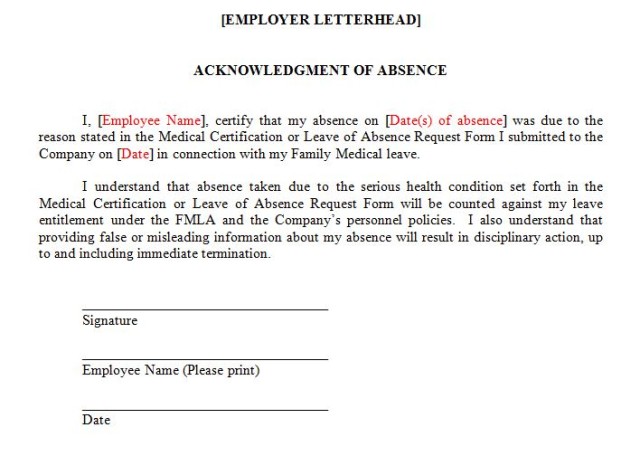
 It’s Webinar Time!
 One FMLA rule that tends to fly under the radar is the amount of FMLA leave available to married couples who work for the same employer.