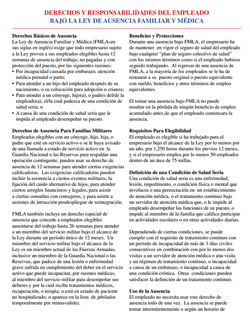
spanish posterOver the past several months, a number of employers have asked me when the Department of Labor would be issuing the Spanish version of its new DOL poster (which accounts for the new regulations issued earlier this year).  The time has come – the poster is here. 

Under the FMLA, an FMLA-covered employer must post a copy of the General FMLA Notice in each location where it has any employees (even if there are no FMLA-eligible employees at that location). According to the FMLA rules, the notice must be posted “prominently where it can be readily seen by employees and applicants for employment.”

Per the DOL, where an employer’s workforce “is comprised of a significant portion of workers who are not literate in English, the employer shall provide the general notice in a language in which the employees are literate.” 29 C.F.R. 825.300(a)(4)

The Spanish version can be found here (pdf).  

In a previous post, we provided additional guidance on why and where employers need to post this DOL poster.  

While I have you, note that the DOL also has a Spanish version of its FMLA Guide (pdf).  For the reasons I stated in another previous blog post, this guide is valuable to employers because it impresses upon employees the obligations they have under the FMLA to cooperate with their employer when they need FMLA leave and what will be expected of them during this process.

We have been sitting on the edge of our seat [ok, perhaps I’m on the seat alone] as we await the Department of Labor’s anticipated regulations interpreting how the Supreme Court’s DOMA decision impacts the definition of “spouse” under the Family and Medical Leave Act.

As you may recall, I predicted earlier this year that the DOL likely would adopt a “state of celebration” rule, in which spousal status is determined based on the law of the State where the employee was married.  Although we don’t have anything definitive, the DOL shot us a sneak preview last week of what this proposed FMLA regulation might look like.

In Technical Release 2013-04 issued on September 18, 2013, the DOL takes the position that — at least with respect to employee benefit plans — the terms “spouse” and “marriage” in Title I of ERISA and its implementing regulations “should be read to include same-sex couples legally married in any state or foreign jurisdiction that recognizes such marriages, regardless of where they currently live.”  This guidance comes on the heels of the IRS’ own guidance, which late last month confirmed its position that a same-sex couple is considered married (for federal tax purposes) so long as the couple was married in any state (or U.S. territory or foreign country) that recognizes same-sex marriage.

In a DOL press release announcing its new guidance, Secretary Thomas Perez stated that the Supreme Courts Windsor (DOMA) decision “represents a historic step toward equality for all American families, and I have directed the department’s agency heads to ensure that they are implementing the decision in a way that provides maximum protection for workers and their families.”

State of celebration rule?  It’s likely only a matter of time.

Let’s hear from you, DOL.  We await your guidance on our favorite federal law!

Photo credit: WillisWire

Pink floyd.jpgHello…hello…hello…is there anybody in there? Just nod if you can hear me. Is there anyone home?  

Have your employees have become so evasive in their requests for medical leave that you feel like signing Pink Floyd’s “Comfortably Numb” to get them to talk? Have no fear — you don’t have to become that numb in order to effectively administer FMLA in these situations.

Take heart — in case after case in 2013, federal courts everywhere have been slapping down FMLA lawsuits where the employee either: 1) failed to follow the employer’s customary call-in procedures; or 2) neglected to provide the employer enough facts to indicate that an absence might be covered by FMLA. We have one good thing going: courts are far less forgiving when employees don’t properly communicate with their employers about their need for leave.  As a result, I encourage employers to be more aggressive when it comes to requiring notice under the FMLA.

Here are a few recent real-life examples that should bolster our confidence as employers:

  • As Eric Meyer noted recently in his employment blog, an employee who needed hernia surgery (an absence that otherwise would be covered by FMLA leave) assumed that he did not need to call in his absences while he was out for the surgery because he had previously met with his employer to discuss his upcoming surgery.  However, the employer’s policy required him to call in more frequently, and when it didn’t, his failure to do so equated to a bunch of unexcused absences — and his termination.  White v. Dana Light Axle Manufacturing (pdf)
  • A federal appellate court ruled earlier this summer that an employee’s text message requesting to be taken off 24-hour-call duty on one night was insufficient to put the employer on notice that she was requesting FMLA leave to care for her father. Lanier v. Univ. of Texas Southwestern Medical Cntr. (pdf)  Same result in another “texting” case, where the employee simply texted that she was not well, and even after much prompting, texted, “As of today, I will be off until July 12th per my doctor for medical reasons.” Here, the court found these messages were insufficient to trigger FMLA protections and the plaintiff’s FMLA claims were dismissed.  Banaszak v Ten Sixteen Recovery Network (pdf)
  • Just last week, a federal trial court knocked out FMLA claims by a fire battalion chief because he simply failed to inform the fire department that he would be taking several days of sick for a follow-up procedure on his heart.  When pushed, the employee could not remember if he told his employer any details whatsoever as to the reasons why he was missing work.  This level of evasiveness doesn’t cut it when it comes to the FMLA. Freeman v. City of Little Rock (pdf)

Insights for Employers

What are the takeaways from these cases? 

  1. Maintain effective call-in procedures:  Every employer should maintain a call-in policy that, at a minimum, specifies when the employee should report any absence (e.g., “one hour before your shift”), to whom they should report the absence, and what the content of the call off should be.  If you don’t have call-in procedures set up in an employee handbook or personnel policy that is distributed to employees, begin working now with your employment counsel to put these procedures in place. They will help you better administer FMLA leave, combat FMLA abuse and help you address staffing issues at the earliest time possible.
  2. Require actual information from your employees! How many of you allow your employees to leave cryptic messages for you on Company voicemail when reporting an absence? Do you have a practice of returning these voicemail messages? How many of you actually probe with further questions the reason for the call off? A couple of thoughts to obtain the information you need to determine whether FMLA applies.

• First, include very clear language in your FMLA and other leave policies about how you expect your employees to communicate with you regarding the need for leave of any kind. (In your policy, you’ll also want to include expectations for completing a leave of absence request form, which I also recommend.) My “model” policy provision looks something like this:

• When you contact Human Resources to report your need for leave, you must provide at least the following information:

o The specific reason for your absence, with sufficient information to allow the [Employer] to determine whether the FMLA may apply to your request;

o When your leave will begin and when you expect to return to work, including specific dates and times of absences, if known;

o A telephone number where you may be reached for further information.

• Second, ask questions of your employees to elicit enough facts about their absence so you can be in the best position to determine whether FMLA might be in play. As you have read in my previous blog posts, I recommend using a script of questions to assist you in your efforts.

If all else fails, perhaps you consider belting out a few bars from “Comfortably Numb” [“Relax. I need some information first. Just the basic facts. Can you show me where it hurts?“]. That sounds a little creepy, so don’t do that.  

But you get my point.

Do you know what’s particularly oppressive about the FMLA? [You: Jeff, everything about the FMLA is oppressive!]

The requirement that an employer return an employee to the same or equivalent position at the end of FMLA leave.

Returning an employee to the same position is easy enough to grasp.  The same is the same is the same.  But often, the same isn’t available, so the employer is left wondering what exactly is an equivalent position?  Here’s where the FMLA gets oppressive.  Under the FMLA regulations, an equivalent position is:

one that is virtually identical to the employee’s former position in terms of pay, benefits and working conditions, including privileges, perquisites and status. It must involve the same or substantially similar duties and responsibilities, which must entail substantially equivalent skill, effort, responsibility, and authority.

Several words here scare me: virtually identical, same, must involve, must entail.  Does this effectively mean that the equivalent position must be identical or the same?  Just about.

JP Morgan Chase recently learned this the hard way.

The Facts

Paula Crawford worked for JP Morgan Chase as a project manager.  In this role, she was required to review government regulations and contract servicing agreements.  The position also allowed her to apply legal knowledge she acquired during her studies in law school.

From December 2007 to February 2008, Crawford took leave for depression and anxiety.  Upon her return, her employment looked something like this:

  • She was placed into a new position: Quality Analyst II, which maintained the same pay, benefits, work hours and location
  • She performed more clerical duties
  • She reported to a former peer
  • The new position did not require the same use of legal expertise
  • Her opportunities for career advancement were diminished in the new role

The Bank’s attorneys argued that Crawford’s new position was an equivalent position because it involved the same salary and benefits.  But herein lies the problem: all too many employers presume that if they provide the employee the same pay and benefits and return him/her to a position that’s “same enough,” they’ve met their obligations under the FMLA.

Not so fast.

Remember those oppressive words above: the new position must be “virtually identical” to the former position, and it must maintain the same privileges, perquisites (“perks”) and status.  The FMLA regulations also tell us that effectively the same skill, effort, responsibility, and authority must be employed, too.  [Read: employers have very little wiggle room.]

The Ruling and Insights for Employers

The court refused to dismiss Crawford’s case above, finding that the new position: 1) did not offer the same career advancement; 2) did not require a similar level of education and training; 3) increased her clerical duties; and 4) did not allow her to utilize her legal skills.  As a result, it found that a jury would have to decide that the new position was not equivalent under the FMLA. Crawford v. JP Morgan Chase (pdf)

What do employers learn from this?

  1. If pressed in a lawsuit, employers must do a better job explaining why the position is virtually identical.  Assuming the facts are true, the bank didn’t do that here, and even worse, it allowed the employee through her own testimony to offer her own spin on the duties of the new position, all of which were not contested by the bank.  If the quality analyst position was indeed the same or virtually identical, then show it!
  2. *Virtually identical* means just that — that is, the new position must be pretty darn close to the last one.  It should not take on more clerical duties or offer a more trecherous route for advancement through the company.
  3. Read carefully part of the court’s opinion: “Even if both [of Crawford’s] positions carried equal pay and benefits, if the Quality Analyst II position did not require a similar level of training and education, then it was not equivalent in terms of status and thus the positions would not be equivalent under the FMLA.”  Seems a bit harsh, as it doesn’t take into account the diversity of positions potentially available in a typical company, but this is what the courts are saying, so we have to take it seriously.
  4. Finally, be mindful of the status of the new position, yet another requirement under the regulations. For example, when you offer a more difficult road for advancement within the company, you arguably change the status of the position, making it difficult to knock out an FMLA claim.

baby yawn.jpgOf course, this kind of stuff happens while I’m on vacation and away from my computer.  Last week, the Wall Street Journal created a bit of an uproar when it reported that the Department of Labor had just issued “regulatory guidance to affirm that same-sex married couples can take a leave from their jobs to care for an ill spouse.” This comes as a result of the Supreme Court’s Windsor decision, which I previously highlighted here.

What was the DOL’s regulatory guidance, you ask? As Dan Schwartz reports in his employment law blog, the DOL simply updated its FMLA Fact Sheets to reflect that the definition of “spouse” under the FMLA also includes those individuals who have entered into a same-sex marriage. Here’s the specific provision from the new Fact Sheet:

Spouse: Spouse means a husband or wife as defined or recognized under state law for purposes of marriage in the state where the employee resides, including “common law” marriage and same-sex marriage.  [My emphasis, not DOL’s.]

This update is hardly surprising. In fact, one might have expected it. On the other hand, the Fact Sheet did not address the definition of “spouse” for those employees in a same-sex marriage who reside in states that do not recognize same-sex marriage.  That’s what we really want to know, right? As I discussed in my previous post, this issue will require some actual regulatory guidance instead of a fairly straighforward change on a Fact Sheet.

Interestingly, in other housekeeping news, the DOL also has indicated that a 1998 opinion letter regarding DOMA’s application to the FMLA is under review in light of the Windsor decision. 

Even the DOL thinks these tweaks are a bit of a yawner since they must have been anticipated. Take a look at their own blog entry here that it posted late last week.

Insights for Employers

Although the Fact Sheet update is hardly earth-shattering news, this tweak by the DOL serves as a reminder to employers that they need to carefully consider what changes they should make now to FMLA policies, forms and procedures to remain compliant with DOL’s updated interpretation of the definition of spouse.  

In particular, if you have employees who reside in states where same-sex marriage is legal, (based on my count, that’s California, Connecticut, Delaware, Iowa, Maine, Maryland, Massachusetts, Minnesota, New Hampshire, New York, Rhode Island, Vermont, Washington, and the District of Columbia), you should work with your employment counsel promptly to make these changes. 

Now back to that nap…

take two.jpgThe feedback from last week’s blog post on annual FMLA certification came fast and furious.  Most of it was complimentary (thank you!), but several of my fellow FMLA nerds raised an interesting issue.  They noted that the FMLA regulation covering “annual” certifications does not specifically state that the certification in the new FMLA year must come in conjunction with an absence.  So, they question whether an employer actually has to wait for the first absence in the new FMLA year before seeking new certification.

At first glance, I see where they are coming from. The regulation on annual certifications is not terribly clear.  It states simply:

Where the employee’s need for leave due to the employee’s own serious health condition, or the serious health condition of the employee’s covered family member, lasts beyond a single leave year, the employer may require the employee to provide a new medical certification in each subsequent leave year.  29 C.F.R. 825.305(e)

An employer might read this provision to mean that it can ask for annual certification at any point in a new FMLA year — with or without a request for leave or an absence by the employee. However, when this regulation was addressed by the Department of Labor during its changes to the regs in late 2008, the DOL indicated that it was relying heavily on an opinion letter it issued on this topic back in 2005.  This essentially answers the outstanding question.  In the opinion letter, the DOL stated:

It is our opinion that an employer may reinitiate the medical certification process with the first absence in a new 12-month leave year . . . This is the case despite the fact that the employer had requested recertification in the previous 12-month leave year. 

So, DOL takes the position annual certification can be done with the first absence in the new FMLA year.  To be clear, if I were litigating the issue, I wouldn’t shut the door to an argument that the DOL’s failure to be more specific in the regulations should be construed against the agency.  But it also seems apparent that DOL intended for an annual certification in a new FMLA year to be subject to the same standards as an initial certification under 29 C.F.R. 825.305(b), which allows the employer to seek initial certification only when the employee first requests leave under the Act.

Still not convinced?  Let’s discuss — I welcome your feedback.

busted2.jpgThe DOL is on a roll, and employers can’t be amused. Over the past few months, the Department of Labor seemingly has issued statement after statement after statement announcing settlements it has reached with various employers in conjunction with alleged FMLA violations. Heck, DOL now even has its own blog highlighting its recent FMLA enforcement. [Hey, where did they get that crazy idea!?!]

Whether it’s improperly denying FMLA leave, mishandling the medical certification process or fudging up return-to-work rules, employers have found themselves in the crosshairs of the DOL lately when it comes to FMLA.

One recent DOL press release stood out to me because it involved a mistake employers occasionally make in the medical certification and recert process.  In this case, the DOL accused a healthcare services company in New Mexico of automatically renewing medical certification requests from employees, even though the request didn’t involve an actual employee absence.

So, the situation goes something like this: let’s say an employer’s 12-month FMLA period is based on a calendar year: January 1 to December 31.  One of their employees, let’s call him A-Rod for fun, suffers from a condition that causes his muscles to inflate involuntarily, causing a very painful condition as well as a wee bit of a personality disorder.  When this condition flares up, A-Rod needs intermittent FMLA leave.  When the new FMLA year begins on January 1, the employer does not wait for A-Rod’s first absence associated with this unfortunate condition. Rather, it sticks him with a certification request shortly after the new year — completely unconnected to any leave request.  The employer administers it this way so that it can get ahead of the game and to ensure that certification is neat and efficient for the rest of the FMLA leave year.

Here, the employer’s *efficiency* violates the FMLA.  When it comes to medical certification, the FMLA rules are clear: 

the employer should request that an employee furnish certification at the time the employee gives notice of the need for leave or within five business days thereafter. . . 29 CFR 825.305(b)

Same holds true for recertification.  Under the regulations, employers may seek recertification at certain intervals or circumstances, but so long as it comes in conjunction with a request for leave. 29 CFR 825.308(a)(b)    

Employers should aggressively enforce their rights when it comes to FMLA, especially during the medical certification process.  However, let’s not go overboard.  Whether you have A-Rod on your team or not, medical certification and recertification requests can only come in conjunction with an employee’s actual request for leave.  If you stray from this rule, you risk becoming the DOL’s next press release.  

mean royal baby.jpgFess up and raise your hand. How many of you were on the edge of your edge of your seat awaiting news of William and Kate’s new arrival?  I can picture you now, feverishly refreshing your Facebook and Twitter pages to catch a glimpse of the latest heir to the British throne.  

As we await a name for this new little British bundle, I found myself a bit envious over the fact that William and Kate can take just as much parental leave as they’d like to bond with their newborn child. In fact, given his family bloodlines, William can take all the bonding time he’d like, as he surely will not ascend the throne any time soon. Under British law, William will receive two weeks’ pay from his employer (the Royal Air Force) during the time he will take off. 

But those of us in FMLAland can’t help but wonder what paternity leave rights William would have if he were a regular ‘ol chap living and working in the land of the free and the home of the brave.  

So, let’s us assume for a moment [or less, if you’re already disturbed by this article] that Prince William was instead “Billy Windsor,” a born and bred Hoosier, living and working in Fortville, Indiana.  There, he works for Chuck, a successful breeder of polo horses, and an employer of thousands of other Billies, Bobs and some Susies in Fortville.  

Naturally, Billy Windsor is a good dad, and he has requested that Chuck give him time off attend prenatal visits with Kitty (the mom), and later, to bond with his newborn child — name to be determined.  

Can Billy take FMLA leave to attend Kitty’s prenatal visits?

Hear ye, hear ye, Billy.  You can take FMLA leave for prenatal visits only if you are married to Kitty. Seriously, I’m not talking rubbish.  Under the FMLA regulations, only a husband is entitled to FMLA leave where he is needed: 1) to care for his pregnant spouse who is incapacitated; 2) to care for her during her prenatal care; or 3) to care for her following the birth of a child if she has a serious health condition. Unmarried dads, you’re out of luck.  29 C.F.R. 825.120(a)(5)

Can Billy take FMLA leave to care for Kitty because she’s dealing with complications from pregnancy?

Yes, but subject to the answer directly above.

Can the Employer Require Billy to Obtain a complete medical certification in support of his bonding leave?

No.  Keep in mind that bonding leave is time for mom and dad to get the hang of parenthood and spending quality time with their newborn baby.  Naturally, there is no “serious health condition” involved. Thus, the employer can only obtain information such as confirming the pregnancy, due date and birth of the child.  On the Notice of Eligibility form (pdf), there is a section to request this limited information. For more info on this, check out one of my old podcasts on this topic.

Billy wants to take bonding leave in small spurts — one week here, a few days there.  Can Chuck require him to take bonding leave all at once?

You’re bloody right, Chuck can.  The FMLA regulations are clear: the employee can take intermittent or reduced schedule bonding leave only if the employer agrees.  29 C.F.R. 825.120(b)  

Chuck is a highly unusual fellow in that he provides paid parental leave to his employees.  He gives eight weeks of paid leave to dads and 16 weeks of paid leave to moms.  Does Billy have a viable gender discrimination claim because women in the workplace are treated better than men?

Likely, no.  See my previous post and interview on this topic.  Women in Chuck’s workplace likely are given extra paid time off for the recovery period after childbirth, which generally is recognized to last six to eight weeks.  Gents, stifle it.  Let’s just consider ourselves lucky we’re not the ones giving birth (we’d be whining like babies!) and let’s just tip our cap to the opposite sex on this one.

What if Billy and Kitty both work for Chuck?  What FMLA leave entitlements do they have?

This one is straightforward.  If both spouses work for the same employer, they get snookered on this one. According to the regs, if both husband and wife are employed by the same employer, they can be limited to a combined total of 12 weeks of FMLA leave if leave is taken for the birth of the employees’ son or daughter or for bonding leave.  

Caveat No. 1: This limitation only applies if the parents are husband and wife.  If the parents aren’t married, they each get the full 12 weeks of bonding leave.  Odd loophole in the regs?  Me thinks so.

Caveat No. 2: If one spouse is ineligible for FMLA leave, the other spouse is entitled to up to 12 weeks of bonding leave. Fancy that!

Caveat No. 3: Keep in mind that both parents each can take up to 12 weeks of FMLA leave to care for their child with a serious health condition. The limitation above only relates to bonding leave!

All kidding aside to my fellow Indiana Hoosiers and to the royal family, best wishes not only to William and Kate, but all the moms and dads out there ushering in the next generation! Cheers! This calling isn’t easy.

Photo credit: memegenerator.net 

temp ee.jpgQ: We regularly utilize temporary employees, some of whom we hire permanently. Does the time they work as a temp (through an agency) count toward the 12-month and 1,250 hour eligibility requirements?

A: An employee is eligible to take FMLA leave when, among other things, he/she has worked for the employer for 12 months (which, of course, need not be consecutive) and worked 1,250 hours in the previous 12-month period.

According to the Department of Labor, the time worked as a temporary employee does indeed count toward the 12-month service and 1,250 hour requirement.  In one short sentence in the FMLA regulations, the DOL sums up its position:

joint employment will ordinarily be found to exist when a temporary placement agency supplies employees to a secondary employer. 29 C.F.R. 825.106(b)(1)

This position is only further cemented by a long-standing 1994 DOL opinion letter, in which the agency confirmed that “the time that the employee was employed by the temporary help agency would be counted towards the eligibility tests” under the FMLA.  I wish it weren’t so, but the courts generally have agreed with DOL’s position. Mackey v. Unity Health System (finding that, for FMLA eligibility purposes, “an employee’s term of employment begins once assigned by the temporary agency, rather than when hired as a permanent employee”).

No wiggle room here, as far as the DOL is concerned.  As to FMLA eligibility, a temp employee apparently is no different than a regular employee on day one.  No 326-point joint employer test required. No nothin’. It’s just a done deal.

Since we’re on the topic, one additional point is worth noting with respect to temporary employees: keep in mind that the primary employer (i.e., the temp agency) is responsible for providing the required FMLA notices, administering FMLA leave and maintaining health benefits. The secondary employer (i.e., the one receiving the employee’s sevices) becomes responsible for these obligations only after the individual becomes employee an employee of the secondary employer permanently.

Have you ever suspected that your employee has given you an excuse too rehearsed or provided a doctor’s note a bit too slick in support of their leave of absence? Don’t be fooled: they actually might be paying for the excuse.

Just when we thought we’d seen it all. According to a report from the St. Paul Pioneer Press, for a mere $54, your employees can pay a “deception service” to provide a white lie or alibi to support their request for a day off.

One of the businesses responsible for these tales of woe is Paladin Deception Services. For what some might say is a reasonable $54 fee, this deception company will return a phone call to an employer to vouch for a ficticious doctor’s appointment or support a case of the sniffles.  The sole purpose of this service is to dupe employers into believing the employee’s request is legit.  Says Paladin on its deception web site, the company “will will provide the white lie or alibi that you need regardless the reason, as long as it’s important to you.”

With its moral compass intact, Paladin is quick to point out that there are some lines even this deception company won’t cross.  For instance, it apparently will decline making make false statements or provide fictitious references to law enforcement agencies, courts, banks, medical institutions, government agencies or fire departments.

Well, that’s is a relief, isn’t it!?!

Nevertheless, for the rest of us employers who seemingly are open game, it gives us yet another reason to be concerned about our employees’ sick leave excuses.  Yet, there are many tools available to employers to weed out these tall tales: 1) ask questions of the employee up front to determine whether FMLA might apply; 2) require completion of a leave of absence form that the employee (not the fake doctor) must complete; 3) authenticate and/or clarify the FMLA certification so that you can confirm that the health care provider and reasons for leave are legit; 4) where you have reason to doubt the FMLA certification, use the second and third opinion process; and 5) where an employee’s return to work is a question mark and the information from the employee is fishy, keep in mind my suggestions for seeking an independent medical examination.

In the meantime, though, be on the lookout for guys in dollar-rimmed glasses…

Hat tip: HRBenefits.com and DMEC.