
 On Friday, June 26, the United States Supreme Court ruled that same-sex marriage is a fundamental right under the Fourteenth Amendment to the Constitution.
So, I’ll give you one guess as to the topic of my blog post today.
How is the FMLA Impacted by the Supreme Court’s Ruling on Same-Sex Marriage?
Earlier this year, the Department of Labor issued a final rule allowing an otherwise eligible employee to take FMLA leave to care for a same-sex spouse, regardless of whether the employee lives in a state that recognized their marital status. Now that the Supreme Court has declared that same-sex marriage is a Constitutional right, states can no longer prohibit same-sex marriage. Obergefell v. Hodges (pdf)
As a result of the Supreme Court’s decision, it appears any questions regarding the DOL’s Final Rule have been all but eliminated. This means that employers must permit eligible employees to take FMLA leave to care for their same-sex spouse with a serious health condition, for qualifying exigency leave if the spouse is being deployed and other qualifying reasons.
What About the Four States Covered by the Texas Court Decision Halting Issuance of the DOL’s Final Rule?
As I reported in a previous post, four states (Texas, Arkansas, Louisiana and Nebraska) obtained an injunction stopping enforcement of the DOL’s final rule. Although we don’t know how these four states will proceed in light of the Supreme Court’s decision, the Court’s decision validates the DOL’s definition of “spouse.” The DOL has not yet issued any statement on enforcement in these four states, but employers in these states that elect not to provide FMLA leave to same-sex spouses are taking on significant risk.
What Do Employers Need to do Now?
In another of my previous posts, I gave employers extensive guidance on what they should do in light of the new DOL rule on same-sex spouses. Among other things, employers should:
1. Update FMLA policies and forms.
2. Train supervisors and administrators on the new rule.
3. Determine whether any state leave law applies, as they may differ on their definitions of same-sex marriage, civil unions and domestic partnerships, and may offer different leave rights depending on the protected category.
4. Be mindful that the DOL’s new rule covers individuals who enter into a same-sex marriage. However, the FMLA does not protect civil unions or domestic partnerships, so employers are well advised to determine whether FMLA applies in any particular situation. That said, employers are free to provide greater leave rights than those provided for under the FMLA.

 This one just smells fowl. Delbert (not sure if he goes by Del or Bert, so I’ll just call him Delbert) decided not to show up for work at Tyson Fresh Meats on December 28. Instead, he asked his girlfriend, who also worked for Tyson, to report his absence for him. She obliged and told Delbert’s supervisor that he “would be absent or late” on December 28. On that same day, Delbert texted his supervisor, stating that he was “having health issues, would be out a few days, and needed to see a doctor.”
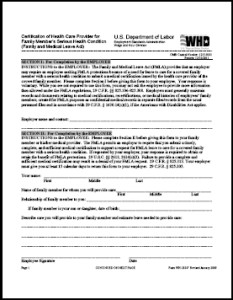 Those sneaky little rascals! While the rest of us were enjoying our Memorial Day holiday, those crazy kids over at the Department of Labor were still working away. This time, they were busy posting the new model FMLA notices and medical certification forms. Expiration: May 31, 2018!
 Last week, I had the pleasure of presenting with EEOC Commissioner Victoria Lipnic on the EEOC’s pregnancy discrimination guidance and how employers should address pregnancy accommodations in the workplace. Our presentation was part of an outstanding FMLA/ADA compliance conference hosted by the
  Is that all it takes to get you to click on my blog entry — make a reference to “sperm” in the blog title and post a silly photo of this little guy? That was like taking candy from a baby!